Post: General Relativity
The last post didn’t include gravity, but it was to introduce you to what we will do in this blog post. This post will give you a clear, brand-new understanding of gravity. It will unravel the mysteries of this attraction and why it is so hard to unify it with the other fundamental forces. I will also provide an example to visualize gravity in your mind.
Curvature of Space-Time
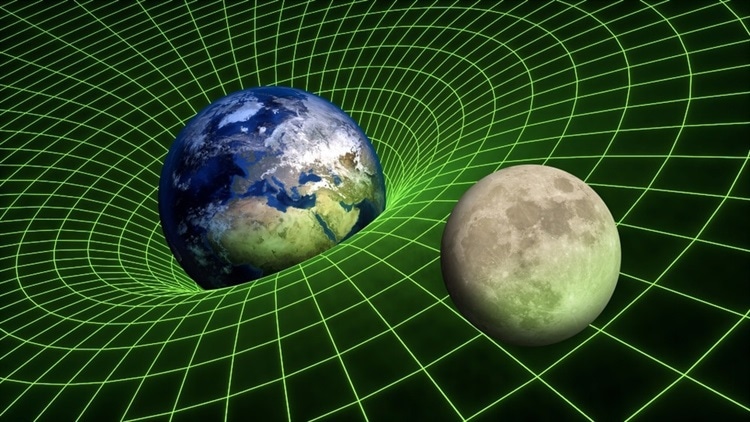
Gravity isn’t actually a force, it is the curvature of space-time caused by mass and energy. When there is a massive object, space-time wraps around it. The smaller object follows that path, and gets attracted by the larger object. This is why time ticks at different rates at different places. When an object bends space-time, it also bends time, which makes it slower.
A Trampoline Example
Imagine you have a trampoline, which is space-time in this example, and you put a heavy bowling ball straight down in the center. Let’s say that was the sun. The sun will create a dip. Now, you put a small marble on the edge. The marble will act as Earth, and it will go rolling toward the bowling ball - that’s how the sun attracts Earth. The sun curves space-time.
Quantum Gravity
After Einstein published his theory of general relativity, he wondered about unifying quantum mechanics and general relativity into a single framework called quantum gravity. Einstein worked on this for many years but never found a solution. This is still a problem we face today. Unifying quantum mechanics and general relativity is necessary for a theory of everything.
Conclusion
You should now have a clear understanding of what gravity actually is: the curvature of space-time caused by mass and energy, which bends time and explains why time ticks at different rates at different places. Einstein’s theory of general relativity is the most successful theory of gravity we have. That concludes this section of my blog. I hope you enjoyed reading this post!